
Depression and the Menopause Transition: What the Evidence Actually Shows
The menopause transition carries real psychiatric risk, and most women are never told that before they are in it.
I see the same presentation over and over in my practice. A woman in her mid-forties sits down and tells me she feels flat, irritable, oddly tearful, and not like herself. She has been sleeping badly for a year. She is still cycling, so nobody has connected her symptoms to her hormones. She has usually been told this is stress, or her marriage, or burnout, or simply what it looks like to have young children and aging parents at the same time. Sometimes she has already been started on an antidepressant without anyone asking a single question about her cycle.
She is not imagining it, and she is not failing at stress management. The years leading up to the final menstrual period are a window of increased vulnerability to depression, and that vulnerability is measurable, replicated across multiple longitudinal cohorts, and biologically plausible.
What follows is what the evidence actually shows, who is most at risk, and how I approach evaluation and treatment when a woman in this stage of life comes to me with mood symptoms.
What the longitudinal data actually show
Three independent prospective cohorts followed women from premenopause forward. The risk of depression goes up during the transition, and it goes up even in women who have never been depressed before.
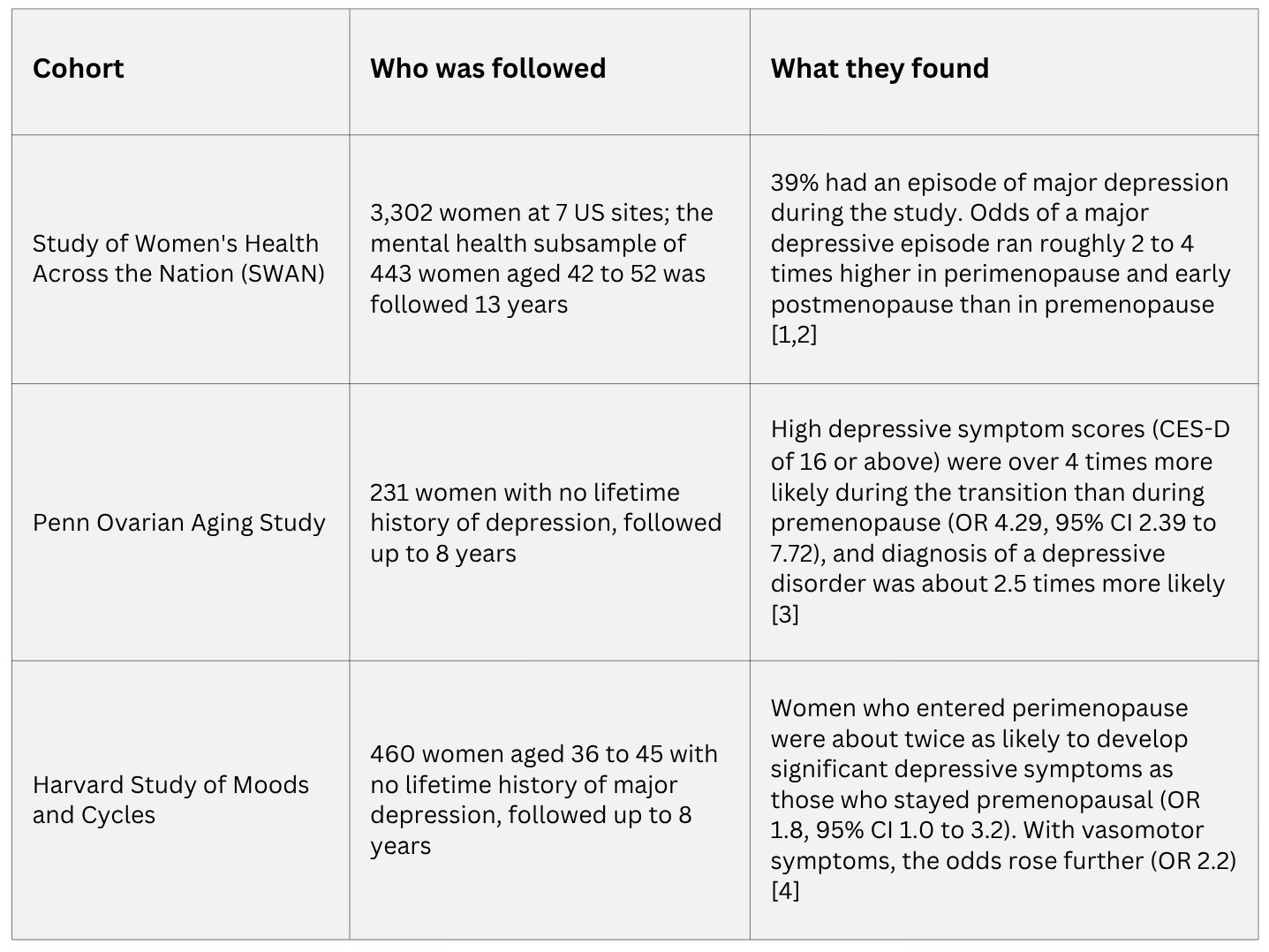
I want to highlight two details.
The first is that the Penn and Harvard cohorts deliberately excluded women with any prior depression. These are first lifetime episodes. No prior psychiatric history is reassuring, but it is not protective during this particular window.
The second is that this appears to be a window rather than a permanent shift. In the Penn cohort, women with no depression history had a low risk of depressive symptoms once they were two or more years past the final menstrual period [5]. The vulnerability concentrates in late perimenopause, when estradiol is swinging hardest, and then it largely settles.
Who is most vulnerable
Not every woman is at equal risk, and the risk factors are specific enough to be clinically useful.
A prior episode of depression. This is the strongest single predictor. In SWAN, 59% of women with a past major depressive episode had another one during midlife, compared with 28% of women without that history [1]. The NAMS guideline makes the same point: most midlife women who meet criteria during perimenopause have been depressed before [6].
A history of mood sensitivity to reproductive events. Premenstrual dysphoric disorder, postpartum depression, or a clear mood shift on hormonal contraception all suggest a nervous system that responds to hormonal change rather than to hormone levels. I take this history in every new patient in this age range.
Frequent or severe vasomotor symptoms. In the Harvard cohort, the odds of depressive symptoms rose further in women with vasomotor symptoms [4]. In SWAN, vasomotor symptoms predicted first-onset depression, though not recurrence in women who had been depressed before [2].
Disrupted sleep. Night sweats fragment sleep, and fragmented sleep is independently depressogenic.
New or worsening anxiety. In the SWAN mental health study, higher anxiety symptoms were associated with significantly greater odds of a major depressive episode at the next annual visit (OR 1.47) [7]. Anxiety that shows up for the first time in the mid-forties needs to be evaluated.
Stressful life events during a period of high estradiol variability. Gordon and colleagues found that estradiol variability predicted depressive symptoms largely in women who had also experienced stressful life events, which suggests the hormonal shift lowers the threshold rather than causing depression on its own [8].
Family history of depression, and surgical menopause, where estradiol drops abruptly instead of over years.
The practical version of all this: a woman in her forties with worsening sleep, new irritability or anxiety, and a history of premenstrual or postpartum mood symptoms is a woman I need to follow up with closely.
Why it happens
The most common misconception I correct, with patients and with colleagues, is that this is about low estrogen. It is not, or at least not primarily.
The better model is sensitivity to hormonal change. We already understand this pattern from premenstrual dysphoric disorder and postpartum depression, where manipulating the hormonal environment reproduces symptoms in susceptible women while absolute hormone levels fail to separate those who get sick from those who do not [8]. Perimenopause looks like the same phenomenon on a longer timescale. Late perimenopause is when estradiol swings most erratically, and that is exactly where the epidemiologic risk concentrates.
Two pathways seem to run in parallel.
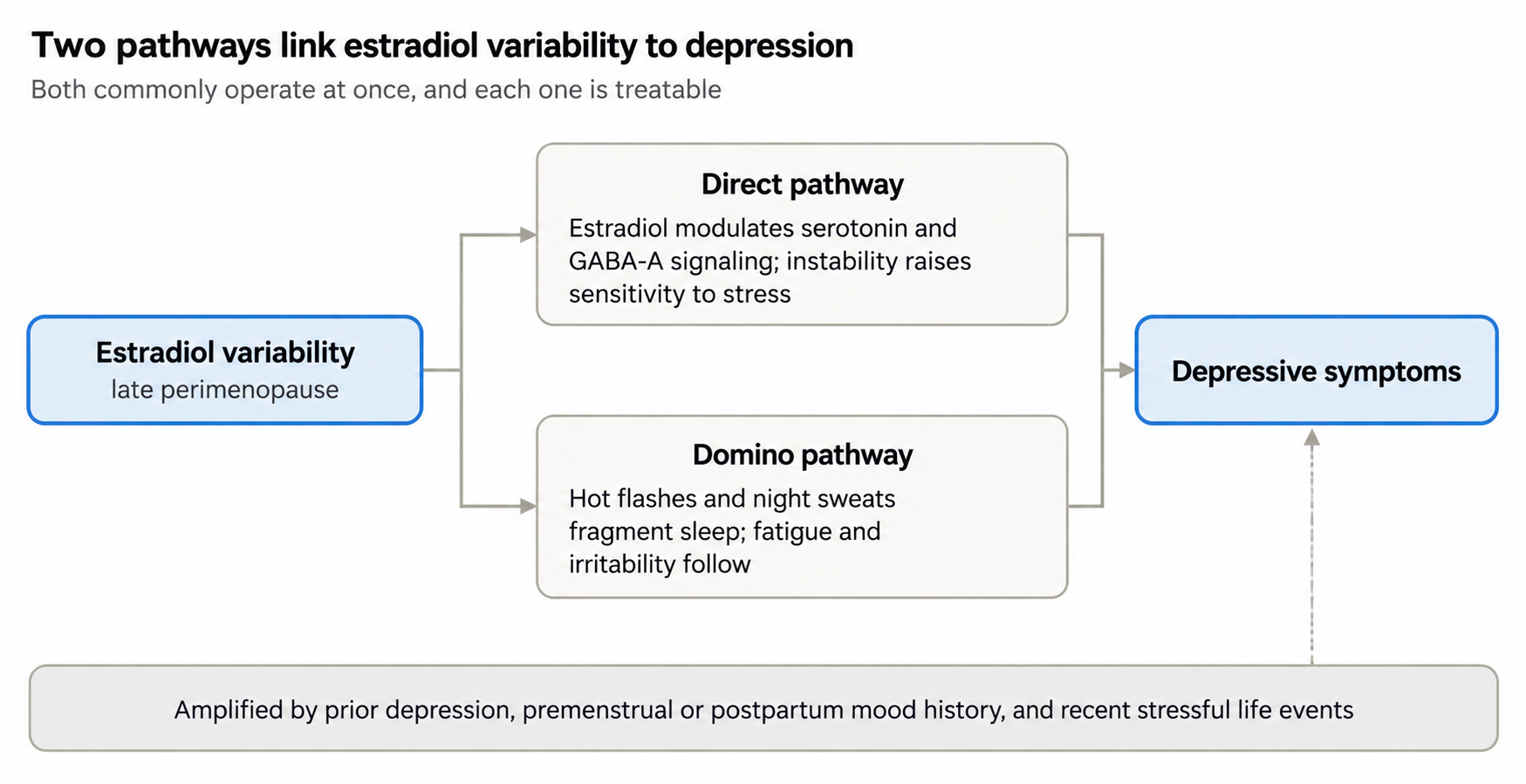
mechanism · 2 pathways, 1 shared endpoint
The direct pathway is neurobiological. Estradiol modulates serotonergic, noradrenergic and dopaminergic transmission and supports BDNF signaling in regions central to emotional regulation. Fluctuating estradiol also drives fluctuation in allopregnanolone, a progesterone metabolite that acts on the GABA-A receptor. Gordon and colleagues have proposed that this unstable GABAergic inhibitory tone destabilizes the HPA axis response to stress, which would explain why stress sensitivity rises during this window [8,9]. In their work, greater estradiol variability was associated with stronger emotional reactivity to psychosocial stress, particularly to social rejection [8].
The indirect pathway is sometimes called the domino hypothesis. Vasomotor symptoms fragment sleep, poor sleep degrades mood and cognition, and the resulting fatigue, irritability and withdrawal start to look like depression. This pathway is real, and it is often the one that is most modifiable.
These are not competing explanations. In most of the women I treat, both are operating, which is why treatment usually has to address more than one of them.
Why it gets missed
The authors of the NAMS guideline were direct about the central problem. Depressive symptoms and menopausal symptoms arrive together and are genuinely hard to pull apart, which makes it difficult to treat these women appropriately [6].
Consider what overlaps. Fatigue. Broken sleep. Trouble concentrating. Low libido. Weight change. Those appear in a depression screen and in a menopause symptom checklist, and a busy fifteen minute visit rarely sorts out which is driving which.
The presentation itself also tends to look different from a textbook depressive episode. What I hear more often is irritability, a short fuse, anxiety that arrives without a trigger, loss of interest in things that used to be absorbing, and mood that swings within a day. Classic melancholic sadness and guilt are less prominent. Women frequently describe it as feeling like a different person rather than feeling sad, and that description does not match what most people, including many doctors, picture when they hear the word depression.
There is also a timing problem. Many of these women are still menstruating, sometimes quite regularly, so nobody is thinking about menopause at all. Staging the transition is clinical and based on changes in menstrual bleeding patterns, not on a single lab value, and a normal FSH drawn on an arbitrary day neither confirms nor excludes perimenopause.
Then there is attribution. These years are genuinely demanding. There are teenagers, aging parents, career inflection points, marriages under strain. It is easy for everyone in the room, including the patient, to decide that a woman who is struggling is simply responding to a hard chapter. Sometimes she is. But stress and a neuroendocrine vulnerability window are not mutually exclusive, and treating only the first one leaves her partly treated.
How I evaluate it
The guideline recommendation is to identify the menopausal stage and assess psychiatric symptoms with validated tools, alongside sleep, vasomotor symptoms, life stressors and the medical differential [6]. In practice, that is five things.
Stage the transition. I use the STRAW+10 framework [10]. A persistent difference of seven days or more between consecutive cycle lengths marks the early transition. An interval of amenorrhea of 60 days or more marks the late transition, which is the highest risk period.
Characterize the mood syndrome properly. Does this meet criteria for a major depressive episode, or is it subthreshold symptoms that are still eroding her quality of life? Diagnosis dictates treatment, so this is important to understand.
Take the reproductive mood history. Premenstrual symptoms, mood during pregnancies and postpartum, response to hormonal contraception. This is the history that tells me whether I am looking at a hormone-sensitive brain.
Map the timeline. I ask when her cycles changed and when her mood changed, and I look at whether those lines track together. I also ask how her sleep was in that same period.
Rule out the mimics. Thyroid dysfunction, iron deficiency in a woman with heavy or prolonged perimenopausal bleeding, B12, vitamin D, and obstructive sleep apnea, which becomes more common after the transition and is badly underdiagnosed in women. I ask about alcohol intake directly, because it tends to go up in this decade and it worsens both sleep and mood.
On screening instruments, one caution. The PHQ-9 and similar tools carry somatic items that vasomotor symptoms and fragmented sleep will inflate on their own. A score is a starting point for the conversation, definitely not a diagnosis.
What the evidence supports for treatment
Antidepressants and psychotherapy remain first line. The NAMS panel was clear that proven treatments for depression are the front-line treatments for perimenopausal depression, and that a woman who responded well to a particular antidepressant in the past should generally be offered that same agent when depression recurs in midlife [6]. Perimenopause does not change the fundamentals of treating a major depressive episode.
Several SSRIs and SNRIs, including escitalopram, venlafaxine, desvenlafaxine and paroxetine, also reduce vasomotor symptoms. When a woman has both depression and significant hot flashes, that overlap can make the medication choice easier.
Estradiol has antidepressant effects, but the timing is everything. The evidence supports an antidepressant effect of estrogen therapy in perimenopausal women, particularly those who also have vasomotor symptoms. The same evidence does not hold in postmenopausal women, where estrogen therapy is ineffective as a treatment for depressive disorders [6]. This distinction gets flattened constantly in popular coverage. Estrogen therapy is not approved for the treatment of depression at any stage, and data on estrogen plus progestin for mood are sparse [6].
On prevention. Gordon and colleagues randomized 172 euthymic perimenopausal and early postmenopausal women to 12 months of transdermal estradiol with intermittent micronized progesterone or placebo. Clinically significant depressive symptoms developed in 17.3% of the treatment group and 32.3% of the placebo group (OR 2.5, 95% CI 1.1 to 5.7, P = .03), and the benefit was concentrated in women earlier in the transition [11]. That is a striking result, and it is also a single trial. The guideline position is that this is not yet sufficient to recommend hormone therapy for preventing depression in asymptomatic women, and that risks and benefits have to be weighed individually [6].
Treat the sleep and the night sweats. The guideline explicitly recommends addressing co-occurring sleep disturbance and night sweats as part of treating menopause-related depression [6]. In my experience this is underused. A woman who has not slept through the night in eight months will not fully respond to an antidepressant alone.
Psychotherapy and exercise. Cognitive behavioral therapy has the strongest evidence base of the psychotherapies here, and CBT for insomnia is worth considering when sleep is the dominant problem. The panel also concluded that recommending exercise is reasonable when it is combined with established psychotherapies and medications [6], which is a more honest framing than exercise as a standalone treatment.
What the evidence does not support. The panel found evidence insufficient to recommend any botanical or complementary approach for treating depression related to perimenopause [6]. I say this as someone who practices integrative psychiatry. Being open to these approaches and being honest about where the data stop are not in conflict.
What I want you to take from this
If you are in your forties and you have not felt like yourself for a while, the most useful thing I can tell you is that there is a biological reason this period is harder, it has been measured repeatedly, and it is treatable. You are not fragile and you are not failing to cope.
It also helps to know that this is a window. The elevated risk concentrates in late perimenopause and then eases in the postmenopausal years. That is not a reason to wait it out, because these years are not ones anyone should have to lose, but it is a reason for hope.
To my colleagues: ask every midlife woman who presents with mood symptoms what her cycles have been doing. It takes thirty seconds and it changes the differential. Ask about premenstrual and postpartum mood history too, because that history identifies the women most likely to struggle now.
And if you are the woman in the chair, bring that history with you. Tell your doctor when your cycles changed, when your sleep changed, and when you started feeling different.
This article is educational and is not a substitute for individual medical advice. If you are struggling with your mood, please talk to a doctor who knows your history. If you are having thoughts of harming yourself, call or text 988 in the US to reach the Suicide and Crisis Lifeline.
References
Bromberger JT, Kravitz HM, Chang YF, Cyranowski JM, Brown C, Matthews KA. Major depression during and after the menopausal transition: Study of Women's Health Across the Nation (SWAN). Psychological Medicine. 2011;41(9):1879-1888.
Bromberger JT, Epperson CN. Depression during and after the perimenopause: impact of hormones, genetics, and environmental determinants of disease. Obstetrics and Gynecology Clinics of North America. 2018;45(4):663-678.
Freeman EW, Sammel MD, Lin H, Nelson DB. Associations of hormones and menopausal status with depressed mood in women with no history of depression. Archives of General Psychiatry. 2006;63(4):375-382.
Cohen LS, Soares CN, Vitonis AF, Otto MW, Harlow BL. Risk for new onset of depression during the menopausal transition: the Harvard Study of Moods and Cycles. Archives of General Psychiatry. 2006;63(4):385-390.
Freeman EW, Sammel MD, Boorman DW, Zhang R. Longitudinal pattern of depressive symptoms around natural menopause. JAMA Psychiatry. 2014;71(1):36-43.
Maki PM, Kornstein SG, Joffe H, et al; Board of Trustees for The North American Menopause Society and the Women and Mood Disorders Task Force of the National Network of Depression Centers. Guidelines for the evaluation and treatment of perimenopausal depression: summary and recommendations. Menopause. 2018;25(10):1069-1085.
Kravitz HM, Schott LL, Joffe H, Cyranowski JM, Bromberger JT. Do anxiety symptoms predict major depressive disorder in midlife women? The Study of Women's Health Across the Nation (SWAN) Mental Health Study (MHS). Psychological Medicine. 2014.
Gordon JL, Rubinow DR, Eisenlohr-Moul TA, Leserman J, Girdler SS. Estradiol variability, stressful life events, and the emergence of depressive symptomatology during the menopausal transition. Menopause. 2016;23(3):257-266.
Gordon JL, Girdler SS, Meltzer-Brody SE, et al. Ovarian hormone fluctuation, neurosteroids, and HPA axis dysregulation in perimenopausal depression: a novel heuristic model. American Journal of Psychiatry. 2015.
Harlow SD, Gass M, Hall JE, et al; STRAW+10 Collaborative Group. Executive summary of the Stages of Reproductive Aging Workshop +10: addressing the unfinished agenda of staging reproductive aging. Menopause. 2012;19(4):387-395.
Gordon JL, Rubinow DR, Eisenlohr-Moul TA, Xia K, Schmidt PJ, Girdler SS. Efficacy of transdermal estradiol and micronized progesterone in the prevention of depressive symptoms in the menopause transition: a randomized clinical trial. JAMA Psychiatry. 2018;75(2):149-157.
